Bitget's $387.5M Heist: The Keys Reportedly Stayed Safe. The Money Left.
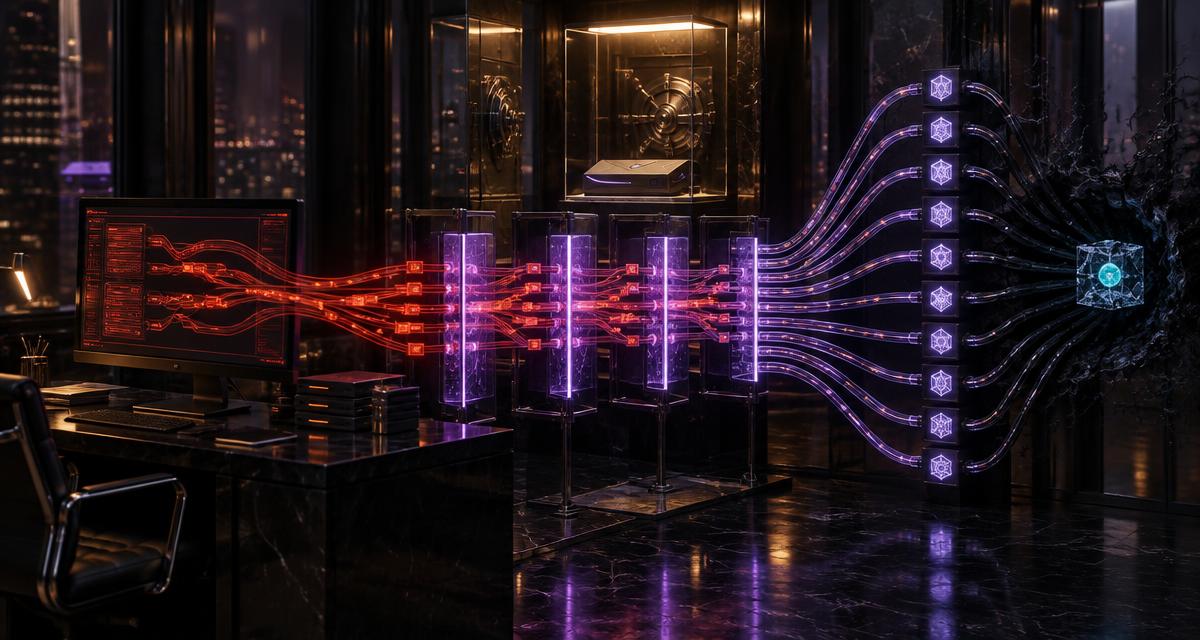
According to Bitget, a third-party zero-day fed forged instructions into a legitimate signing process. The vault did not crack. The paperwork lied.
Bitget first counted $351.6 million. A wider reconciliation found more on TRON and Zcash and raised the total to $387.5 million. The useful lesson is not the larger number. It is that secure keys can still authorize a robbery when the system telling them what to sign has been compromised. This article separates what the public record supports from what remains a company statement — and it does not pretend the two are the same thing. The on-chain transactions are listed in the evidence section below.
The Scheme
Compromise an unnamed third-party security product, dwell inside the wallet stack, forge transaction data, let Bitget's normal authorization process sign it, then scatter the proceeds across 11 chains and convert what can move into harder-to-freeze assets.
What the Public Record Supports
Four independent desks — TRM Labs, Elliptic, BlockSec and Hypernative — published reconstructions that agree on the skeleton of the event: an attacker reached Bitget's wallet-serving infrastructure, fed it forged transfer instructions, and the exchange's own authorization pipeline signed them as legitimate business. CoinDesk carried CEO Gracy Chen's account that spoofed transfers, not stolen keys, moved the money.
The initial $351.6 million estimate was later revised to approximately $387.5 million after additional affected assets were identified on TRON and Zcash. XRP was the largest identified component, followed by ETH and liquid stablecoins. Withdrawals were suspended during containment and restored in stages between 28 September and 2 October.
Here is the boundary, and we will keep returning to it: no public CVE, no named vulnerable product, and no final independent forensic report has been released. The claim that no private key was compromised comes from Bitget and interim investigators. It is plausible and consistent with the on-chain evidence — but the public cannot yet inspect the signing estate that claim rests on.
Four desks agree on the outline. None of them has seen the vault's wiring diagram.
The Vault Door Was Doing Its Job
Bitget says its cold wallets were untouched and no private key was stolen. That sounds comforting until you look at what a signer actually protects. Keys authorize instructions; they do not decide whether those instructions are honest. A perfectly guarded key will happily sign a perfectly fraudulent transfer if the paperwork in front of it has been forged upstream.
That is the architectural lesson of this heist. The attacker allegedly compromised a critical backend system, spoofed destination and amount data, and made fraudulent transfers look eligible for approval. The signatures were valid. The business intent was not. The defense that failed was not cryptography — it was the assumption that whatever reaches the signer deserves to be signed.
An approval system that trusts one backend service is a single point of failure wearing a uniform. The fix is not a stronger lock; it is an independent second opinion that reconstructs destination, asset, amount and policy context before anything is signed.
The lock held. Someone forged the delivery note.
Three and a Half Weeks Inside the Plumbing
SlowMist's interim reconstruction traces the earliest related malicious activity to 31 August, when a zero-day in an unnamed third-party security product was used to reach a database. Similar activity appeared again in September. Bitget later said investigators recovered traces of a custom withdrawal tool from deleted files.
The vendors remain hidden behind the labels Product A and Product B. No public CVE or final forensic report exists yet. The public can see the outline of the intrusion, but not the component name needed to check whether the same weakness sits inside someone else's stack.
That is not a footnote. An unnamed zero-day in an unnamed product means every other exchange running the same vendor is flying blind. The silence may be justified by an active investigation — but until the component is named, the industry's only defense is a warning it cannot act on.
It is the missing address on the fire report.
The Nearly Three-Hour Signing Spree
At 18:31 UTC on 24 September, small test transfers appeared. Large outflows followed from 18:58 and continued, in independent reconstructions, until about 21:23. Bitget says its systems detected unauthorized activity at 18:31 — which raises the uncomfortable question of why the taps ran for nearly three more hours.
Hypernative notes that the forged transactions looked like ordinary traffic except for their gas limits, which were fixed round numbers instead of the values Bitget's own pipeline calculates. Signing went on for about 2 hours 52 minutes after the first unauthorized transfer because nothing downstream checked destination, amount or gas against an authoritative record. The forgery was good. The checking was missing.
The $36 million jump between the first estimate and the revised one came from reconciliation, not a second theft. It demonstrates how unreliable first-night figures are: the earliest number in a multi-chain incident is a floor, not a total.
First you count the smoke. Then you open every room.
Eleven Exits, One Laundering Problem
The affected assets moved across Ethereum, XRP Ledger, Zcash, TRON, Arbitrum, Optimism, Base, BNB Smart Chain, Avalanche, Algorand and Celestia. Liquid stablecoins were swapped quickly; portions of the proceeds were consolidated toward Bitcoin through cross-chain infrastructure.
Issuers and protocols froze roughly $840,000 in reported tranches — around two-tenths of one percent of the revised loss. That matters as evidence of response, not as meaningful recovery. Native assets such as XRP cannot be frozen by an issuer once transferred, and privacy-oriented rails do not cooperate at all.
The dispersion itself is a signature: fast, wide, chain-agnostic laundering aimed at assets that cannot be clawed back. Eleven doors. Most of them opened outward.
The Fund Covered the Headline, Not the Lesson
Bitget said its User Protection Fund held more than $464 million before the incident and would absorb the loss. On the revised figure, one evening represented roughly 84% of that stated backstop. The fund is largely denominated in bitcoin, so its dollar value moves with the market it is meant to insure against.
Bitget also said the fund was replenished above its $300 million floor. Those are company statements. A protection fund is a self-managed reserve, not an insurance policy with an independent underwriter, and its adequacy is a promise, not an audited fact.
Customers keeping their balances is the best possible outcome and it deserves credit. It does not change the arithmetic: the same week, with a slightly larger hole or a weaker bitcoin price, the reserve would have been the story.
The house had a reserve. The burglar still chose the invoice.
Suspected Is Not Confirmed
Bitget's CEO called North Korean involvement very likely. TRM and Elliptic found laundering patterns and on-chain overlaps with clusters previously associated with DPRK thefts. BlockSec offered the necessary restraint: shared laundering infrastructure does not prove the same attacker.
No law-enforcement attribution or final forensic report has publicly closed that gap. The honest label is suspected, not confirmed — and the difference matters, because attribution headlines outlive corrections while the underlying evidence rarely gets the same airtime.
The durable finding is architectural, not geopolitical: an approval system must independently reconstruct and verify what a signer is asked to authorize. Who held the crowbar is a question for investigators. That the crowbar worked is a question for every exchange's engineering team.
Suspected, likely and confirmed are three different evidence states. Only the first two are on the table.
Three Heists, One Shared Weakness
Bitget is not the first exchange to lose a fortune without losing a key. It is the third in three years, and the shared weakness is the same.
May 2024, DMM Bitcoin. According to the FBI and Japan's National Police Agency, a fake LinkedIn recruiter sent a coding test laced with malware to an employee at Ginco, the wallet software vendor DMM relied on. The attackers later used that access to manipulate a legitimate transaction request from a DMM employee. The loss: 4,502.9 BTC, about $308 million. The FBI attributed it to TraderTraitor, a North Korean cluster.
February 2025, Bybit. Investigators from Sygnia and Verichains found that attackers compromised a Safe{Wallet} developer machine and planted malicious code in the interface Bybit's signers used. The signers approved what the screen showed them, and the transaction underneath sent about $1.5 billion to the attacker. The FBI named TraderTraitor again.
September 2026, Bitget. Forged instructions came in through a third party zero day, and the exchange's own pipeline signed them. Investigators suspect North Korea; nobody has confirmed it. The method, however, is already on file.
Notice what was reportedly never attacked: the keys (for Bitget, that is the company's claim). Each time, the crooks went for the supplier and the instruction, the two places a signer trusts without checking. A vault is only as honest as the paperwork slid under its door.
Three vaults, three suppliers, one shared weakness.
What Must Change Before the Next Invoice
Signing systems should independently reconstruct destination, asset, amount and policy context instead of trusting one backend service. Approval paths need transaction simulation, independent limits and anomaly controls that a forged internal request cannot bypass.
Detection at 18:31 with outflows until 21:23 also means the kill switch was slower than the thief. Containment has to be measured in minutes, and withdrawal tooling recovered from deleted files tells you the attacker planned for exactly that delay.
For users, the lesson is colder: an exchange's keys being safe is not the same as your balance being safe. Solvent platforms can still suspend withdrawals during containment, and a protection fund is a promise denominated in a volatile asset. Size your exchange exposure accordingly.
They did not pick the lock. They rewrote the instructions the lock obeys.
Verify It Yourself: On-Chain Evidence
All five transactions below were checked on Etherscan on 17 October 2026. Address labels such as Bitget 6 and Bitget Exploiter 1 are Etherscan labels, not CryptoStrapon findings.
| Time (UTC, 24 Sep 2026) | Asset and amount | From | To | Transaction |
|---|---|---|---|---|
| 18:31:11 | 0.84 ETH(test transfer) | Bitget 6 0x1AB4973a48dc892Cd9971ECE8e01DcC7688f8F23 | Bitget Exploiter 1 0x770b10b273fC44Fe9197D6bF20F145c2e98463Ee | 0xc19560f5…c37be6 |
| 18:58:59 | 34,751,168.12 USDTUSDT contract 0xdAC17F958D2ee523a2206206994597C13D831ec7 | Bitget 6 0x1AB4973a48dc892Cd9971ECE8e01DcC7688f8F23 | Bitget Exploiter 1 0x770b10b273fC44Fe9197D6bF20F145c2e98463Ee | 0xa3ae35a0…599ce5 |
| 19:01:35 | 7,130.86 ETH | Bitget 6 0x1AB4973a48dc892Cd9971ECE8e01DcC7688f8F23 | Bitget Exploiter 1 0x770b10b273fC44Fe9197D6bF20F145c2e98463Ee | 0x67a7ac52…48930c |
| 20:09:11 | 1,879.20 ETH | Bitget 6 0x1AB4973a48dc892Cd9971ECE8e01DcC7688f8F23 | Bitget Exploiter 1 0x770b10b273fC44Fe9197D6bF20F145c2e98463Ee | 0xdd07e880…5af606 |
| 21:23:11 | 223.20 ETH | Bitget 6 0x1AB4973a48dc892Cd9971ECE8e01DcC7688f8F23 | Bitget Exploiter 1 0x770b10b273fC44Fe9197D6bF20F145c2e98463Ee | 0x23055829…449afb |
First-hop attacker addresses (as published by Halborn, not independently verified by CryptoStrapon)
- EVM chains: 0x770b10b273fC44Fe9197D6bF20F145c2e98463Ee (TRM Labs lists the same address)
- XRP Ledger: rwNhefsz1UQEusxhCvHip3RANinWi4CTck
- Tron: TBWNguTTgezw9dVorX441C6nDrZpRxYwKD
- Zcash: t1WgMdtND8NF7NDUuYmq8MpMj1NTCXkMDVG
Bitcoin CoinJoin transaction that BlockSec links to attacker funds: 2380584fe493b68403b1e1d5848118590c9b8c323efe630426e26b15523f125e, confirmed 27 Sep 2026 11:03 UTC (block 968830). The link to the attacker is BlockSec's analysis, not ours.
Freeze breakdown as reported by BlockSec: Tether about $239K, Circle about $100K, NEAR Intents about $503K frozen mid-execution, total about $840K.
Timeline
2026-08-31
SlowMist traces the earliest related malicious activity to a third-party product zero-day.
2026-09-24 18:31 UTC
Test transfers appear; Bitget records detection of unauthorized activity.
2026-09-24 18:58–21:23 UTC
Major multi-chain outflows continue through the core theft window.
2026-09-25
Bitget describes backend spoofing, rules out key theft, and revises the loss to $387.5M.
2026-09-28–10-02
Withdrawals resume in stages while investigators publish interim findings.
2026-10-01
Bitget confirms an unnamed third-party zero-day as the stated root cause.
The Numbers
$387.5M
Revised affected assets
Raised from $351.6M after TRON and Zcash reconciliation.
11
Affected chains
Ethereum, XRPL, TRON, Zcash and seven more networks.
~84%
Share of stated fund
Revised loss versus Bitget's pre-incident $464M+ protection fund.
~$840K
Reported frozen
About 0.2% of the revised loss, not a broad recovery.
Red Flags
- An exchange or vendor blames an unnamed third-party product and gives no CVE, no component name and no timeline for disclosure.
- Loss figures are revised upward days later — treat every first-night number in a multi-chain incident as a floor.
- Freeze amounts are celebrated in headlines without being compared to the total loss.
- A 'protection fund' is cited as proof of safety without an independent audit of its size, custody or denomination.
- Attribution to a state actor is announced by the victim before any law-enforcement or final forensic confirmation.
How to Protect Yourself
Audit the instruction path
Ask how destinations, amounts and policies are independently verified before signing — not just how keys are stored.
Treat exchange funds as freezeable
A solvent exchange can still suspend withdrawals during containment. Keep only operational balances on any platform.
Read attribution labels literally
Suspected, likely and confirmed are different evidence states. Trade and panic accordingly.
Discount first-night figures
In multi-chain incidents the earliest loss estimate is a floor. Wait for reconciliation before drawing conclusions.
“The keys never left the vault.”
The instructions did the walking.
Frequently Asked Questions
Sources & Citations
Research for this investigation compiled from publicly available blockchain data, security reports, and community documentation.
www.coindesk.com · 25 Sept 2026
www.trmlabs.com · 25 Sept 2026
www.elliptic.co · 25 Sept 2026
www.hypernative.io · 27 Sept 2026
blocksec.com · 30 Sept 2026
thehackernews.com · 1 Oct 2026
decrypt.co · 25 Sept 2026
news.bitcoin.com · 25 Sept 2026
www.fbi.gov · 23 Dec 2024
www.bleepingcomputer.com · 24 Dec 2024
www.fbi.gov · 26 Feb 2025
www.bleepingcomputer.com · 26 Feb 2025
thehackernews.com · 27 Feb 2025
Halborn · October 2026 (information as of 2 October 2026)
Verification: On-chain references: 5 Ethereum transactions checked on Etherscan by CryptoStrapon, plus first-hop attacker addresses (Halborn) and a Bitcoin CoinJoin transaction (BlockSec) as published by those firms.
Methodology: Every case needs at least two independent sources before publication, plus verifiable on-chain evidence whenever a public transaction trail exists. Full standards: /methodology
Legal notice: This assessment is based on publicly available data, including on-chain records, official statements and reported incidents. It is journalistic and educational analysis, not legal advice, an accusation of criminal conduct or a court finding. Named companies, projects, domains, wallets and individuals are described as reported by the cited sources; a company name may appear because fraudsters impersonated it, not because the company did anything wrong. If you believe something is inaccurate or out of date, write to cryptostrapon@pm.me and we will correct it and log the change. Editorial policy
More Scam Warnings
Continue learning about crypto threats
7 Crypto Wallet Scams Draining Victims in 2026
Wallet Security • 2026-06-24
Phishing apps stole $4.6B in 2025. See real attack screenshots, fake seed phrase tricks, and the 3-step verification that stops 99% of wallet drains.
Flash USDT Scam Explained: Fake Tokens and Seller Tricks
Token Scam • 2026-06-24
What Flash USDT means, how fake balances and seller pitches deceive, and where to check payments, network contracts, software offers and honeypots.
Black Bitcoin: Why 'Cheap BTC' Is Stolen Money
OTC Fraud • 2025-08-01
70% off Bitcoin sounds great — until Chainalysis traces it to your wallet. See how 'tainted' crypto gets you flagged, frozen, and investigated.