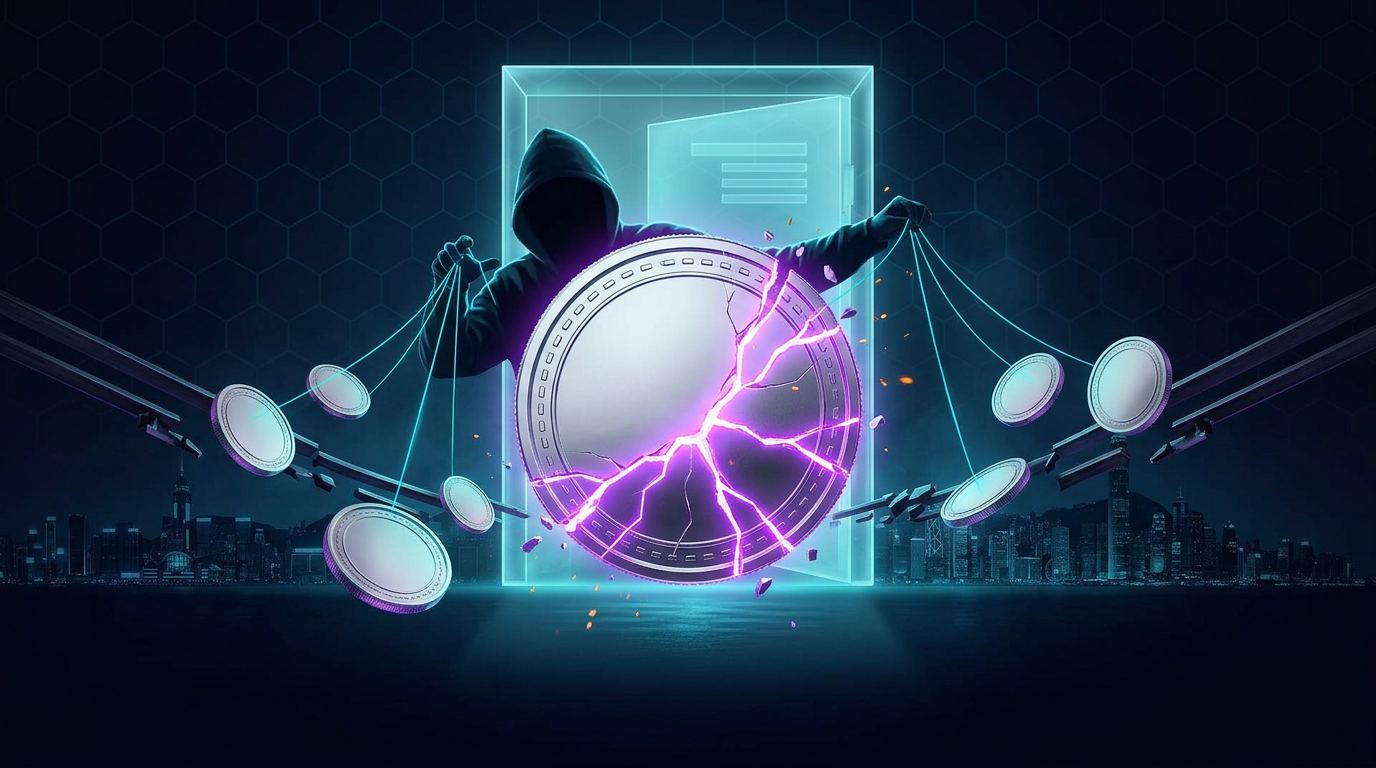
Fake HSBC and HKDAP Stablecoins: Hong Kong License Window Exploited
The license is real. The token isn't.
On April 10, 2026, the Hong Kong Monetary Authority issued the city's first stablecoin licenses to a small group of institutions — including HSBC and Anchorpoint Financial. The real tokens don't go live until the second half of 2026. Eighteen days later — April 28 — tokens trading as HSBC and HKDAP appeared on decentralized exchanges, complete with marketing pages, fake audit PDFs, and a Telegram support desk that answers in three languages. Nothing was issued. Nothing was backed. Everything was being sold.
The Scheme
Hong Kong made global headlines: 'first regulated stablecoin licenses in Asia.' The headline was correct. The scammers read the same headline. They deployed ERC-20 tokens on Ethereum, BNB Chain, and TRON, named them HSBC and HKDAP, listed them on permissionless DEXs, and ran paid Telegram ads to retail buyers in Hong Kong, Singapore, and the Philippines. There is no real HSBC token on-chain yet. There is no real HKDAP token on-chain yet. There is, however, confirmed trading activity in fake tokens, though no official liquidity or victim-count figures have been published.
When a regulator opens a door, scammers walk in first. They always have. The door was a license window. The window was open for 18 days before anyone shipped a real token through it.
Case File Update
Sources replaced with the HKMA release and press coverage.
Series: Token Scams
How scammers evolved from simple fake tokens to sophisticated wholesale operations.
Another scam abusing the USDT name: fake USDT transfers (Flash USDT scam).
The License Window Nobody Was Watching
Hong Kong's Stablecoins Ordinance went into force on August 1, 2025. The Monetary Authority spent eight months reviewing applications. On April 10, 2026 it announced the first wave of approvals — HSBC, Anchorpoint Financial, and two other institutions, with public statements that the actual fiat-backed tokens would roll out 'in the second half of 2026' after final operational audits. Eight months of due diligence. A clean announcement. A clear roadmap.
Stablecoins have one thing buyers care about: an issuer they trust. The HKMA announcement created that trust signal — globally, in 36 hours of press coverage — for tickers that did not yet exist on any blockchain. The scammers had a five-month gap to operate inside the gap between announcement and deployment. They needed less.
By April 28, fake HSBC tokens were live on Uniswap, PancakeSwap, and JustSwap. The contract addresses came from anonymous deployer wallets funded through Tornado Cash mixes. The token metadata pointed at a bank-adjacent lookalike domain — an hsbc-<something> hostname (illustrative pattern; we publish no lookalike hostnames, and the ones written here are not registered domains. The real HSBC owns hsbc.com; the scam wasn't trying to pass as the bank's site, only to look adjacent enough). The HKMA warning came out the same day. The warning had to compete with the marketing.
The license created a brand. The brand existed before the product. Whoever could print first, won.
Why 'No Contract To Verify Against' Is The Whole Vulnerability
Every other stablecoin scam in 2024 and 2025 had a counter-weapon: a real on-chain contract address. If somebody DMs you a USDT token, you compare it against the official Tether contract — there is exactly one canonical address per chain — and the fake collapses. The check takes ten seconds.
HSBC's and HKDAP's real contracts don't exist yet. There is no 'official' address to compare against. The licensed issuer has confirmed the intention to issue tokens. They have not deployed. Which means every deployed token claiming to be HSBC or HKDAP is fake, by definition — but the buyer can't perform the usual check, because the check requires the real address to exist.
The scam exploits the announcement window: regulator says 'these issuers are licensed,' buyers say 'I want in early,' scammers say 'here, early access.' The only people who know there is no real contract yet are the issuers themselves and anyone who reads the HKMA press release line by line. Most retail buyers read the headline. The headline said 'licensed.'
A license is not a token. A press release is not a contract. The gap between those four nouns was the entire attack surface.
Vocabulary, Decoded
What the scam Telegram channels said vs what the on-chain reality is:
"Official HSBC Stablecoin — Pre-Launch Allocation"
Sounds like: An early-bird allocation of the regulated HSBC HKD-backed stablecoin, made available to retail buyers before the public launch window.
Reality: HSBC has not issued any stablecoin on any chain. The 'pre-launch allocation' is an unrelated ERC-20 token deployed by an anonymous wallet, with no relationship to HSBC, no HKD backing, no audit, and no path to becoming a real HSBC token at any future date.
"HKDAP — Hong Kong Digital Asset Platform"
Sounds like: A named licensed digital asset platform token, regulated under the HKMA's stablecoin framework.
Reality: There is no entity called 'Hong Kong Digital Asset Platform' on the HKMA's published licensee list. The name was reverse-engineered to sound official: a real-sounding acronym, a credible English expansion, a logo generated to look like a Hong Kong government mark. The token is unbacked. The name is invented.
"Audited By [Big Four Accounting Firm]"
Sounds like: An independent reserves audit by a globally-recognised accounting firm, of the kind real stablecoins like USDC publish monthly.
Reality: The 'audit PDF' is a Photoshop job using the firm's logo without permission. The PDF metadata shows it was created in Canva three days before the token launch. No accounting firm's genuine audit of these tokens has been published.
A real audit takes six weeks. A fake PDF takes six minutes. Both look the same in a Telegram preview.
How A Fake Stablecoin Becomes A Real Loss
The mechanics are old. The branding is new. The five steps work because they always have:
Step 1: Read The Regulator's Press Release
The HKMA announcement of April 10 listed licensed issuers by name and confirmed the H2 2026 launch window. The list was public, the names were searchable, the launch gap was open. The scammers didn't need inside information — they needed reading comprehension.
Public information weaponises faster than private information. There is more of it.
Step 2: Deploy The Token Where Anyone Can
An ERC-20 deployment on Ethereum costs ~$80 in gas. On BNB Chain it costs ~$3. The scammers deployed on three chains for redundancy. Token name: HSBC. Symbol: HSBC. Decimals: 6. The deploying wallet had been funded the day before via a Tornado Cash withdrawal. The deployment is permissionless. No regulator approves an ERC-20 mint.
The chain doesn't check trademarks. Trademark law assumes the trademark office is somewhere downstream. On-chain, it isn't.
Step 3: Seed Liquidity And A Believable Price
The scammers seeded a Uniswap pool for the fake HSBC token and set an initial price presented as 'pegged-to-HKD.' No official figures for the seed liquidity or price have been published. Reported red flags include a thin pool where buys moved the price up and sells were rejected by a hidden honeypot function in the contract.
Pegged stablecoins have one job: stay flat. This one was flat because nobody was allowed to sell.
Step 4: Run The Marketing The Real Issuer Hasn't Run Yet
Telegram groups in Cantonese, Mandarin, Tagalog, and English. WeChat broadcasts to overseas Chinese communities. A landing page on an HSBC-adjacent lookalike domain — pattern only, not a registered domain we can name (real HSBC domain: hsbc.com). Paid YouTube influencer placements with screen-grab thumbnails of the HKMA announcement. The fake audit PDF as a 'proof' attachment. Every channel claimed 'official partner of HSBC HK.' None of them were.
The real HSBC's marketing for the real token was scheduled for Q3 2026. The fake HSBC's marketing was already running in Q2. First mover advantage is real even when the mover is fake.
Step 5: Wait For The HKMA Warning, Then Pivot
On April 28, the HKMA issued a public warning naming HSBC and HKDAP impersonation tokens. By April 30, the scammers had launched two new fake tokens with adjusted names: 'HSBC-HK' and 'HKDAP-V2'. By May 12, they were calling them 'Phase 2 Pre-Allocation.' The names mutate. The contract logic doesn't.
The HKMA warning was the marketing budget the scammers didn't have to pay for. It put the names in front of more people. Some of them bought, just to see.
Technical Kill Chain: From License Press Release To Drained Wallet
Reconstructed from HKMA warnings and press coverage:
T+0 days: HKMA Issues First Stablecoin Licenses
April 10, 2026: HKMA announces approval of stablecoin issuer licenses. HSBC, Anchorpoint, and two other institutions named. Launch window: H2 2026. Press coverage globally within 36 hours.
The press release was clear that no tokens were yet live. Most secondary coverage compressed 'licensed to issue' into 'launched.' The compression was the entry point.
T+12 days: First Fake Contracts Deployed
Reportedly, anonymous wallets deployed look-alike contracts across multiple chains, including Ethereum, BNB Chain and TRON, styled as ERC-20 / BEP-20 / TRC-20 tokens. No independently verified contract addresses for these tokens have been published.
Honeypot contracts are detectable with tools like honeypot.is in about 30 seconds. None of the scam Telegram channels recommended running that check. They recommended buying within the next hour 'before the allocation closes.'
T+18 days: HKMA Public Warning Issued
April 28, 2026: HKMA publishes a warning naming the impersonation tokens and confirming that HSBC and Anchorpoint Financial had not issued any such tokens. The denial comes through the HKMA release, not a separate HSBC statement.
Regulator warnings travel through institutional channels. Scam ads travel through paid channels. The institutional channels reached the people who weren't buying. The paid channels reached the people who were.
T+20-50 days: Liquidity Drains In Tranches
Reports describe scammers withdrawing liquidity after an unspecified number of buyers bought into the contracts. No official figures for the number of wallets affected or the amount extracted have been published.
The honeypot design means most buyers will not realise they have been scammed for weeks — their wallet still shows the 'HSBC' balance, the token price still shows 'pegged.' The realization only arrives when they try to sell.
T+60+ days: New Token Names, Same Contract Logic
Late May onward: the operation pivots to 'HSBC-HK,' 'HKDAP-V2,' 'HKDAP-Phase-2.' Same deployer wallet families. Same honeypot transfer function. Same Telegram playbook with updated banner art.
Closing one scam token doesn't close the operation. The operators are running an assembly line. Each new name buys another two-week window before the next warning catches up.
Eighteen days from license to scam token. Two days from scam token to liquidity. Six weeks from liquidity to the next fake name. The schedule was inside the regulator's own timeline.
Real Scam Messages: What The Telegram Channels Actually Said
Intercepted from public scam channels in Cantonese, Mandarin, and English. Identifying details removed:
"🎉 OFFICIAL: HSBC Stablecoin (HSBC) — Pre-Launch Allocation Now Open. Licensed by HKMA April 10. Buy on Uniswap. Phase 1 closes in 4 hours. Allocation limited per wallet."
Translation: 'A licensed thing exists somewhere. This is not it. The deadline is here to stop you reading. The contract address is here to look thorough. The countdown is here to remove your last opportunity to check.'
HSBC has issued zero tokens. The HKMA's licensing list does not authorise pre-launch retail sales by anyone. The phrase 'allocation limited per wallet' is artificial scarcity — the deployer can mint unlimited tokens at any time. The 4-hour countdown resets every 4 hours.
"📑 Reserves audit completed by [Big Four Firm]. HKD 1:1 backed. Full PDF attached. Auditor confirms 100% collateralization. All HKMA disclosures met. Buy with confidence."
Translation: 'We made a PDF. The PDF has a logo. The logo belongs to someone else. There is no genuine audit behind it.'
Real Big Four reserve audits are published on the issuer's official site under their compliance section, not delivered as Telegram attachments. Real audits include the auditor's verifiable engagement letter and the issuer's reserve wallet addresses for independent verification. This PDF includes neither.
"⚠️ HKMA warning today targets fake copies — NOT our official token. Verify on Etherscan. HKMA is protecting incumbents. Our token IS the licensed issuer's pre-launch. Don't fall for the FUD. Window closes in 24 hours."
Translation: 'The regulator warned about us. We're now warning you about the regulator. The contract address is real. What's at the contract address is not.'
Etherscan shows the contract is real — it's an ERC-20, it has a deployer, it has holders. Etherscan does not verify whether the contract is what its name claims to be. 'It's on Etherscan' is the same statement as 'it's on-chain.' Both are true. Neither tells you who deployed it.
Red Flags The HKMA Already Wrote Down
- •Token live before the licensed issuer has said it will be — Real HSBC and HKDAP tokens are scheduled for H2 2026. Any HSBC or HKDAP token traded before that date is, by definition, not the licensed product. The issuer has not approved anyone else to mint it.
- •Sells reverting with no error message (honeypot pattern) — When the transfer function silently fails for non-deployer addresses, it's a honeypot. honeypot.is, GoPlus, and TokenSniffer all flag this in under a minute. Most scam channels do not link to these tools.
- •Audit PDF delivered by Telegram instead of issuer's website — Real stablecoin audits live on the issuer's compliance page with verifiable wallet addresses. A PDF in a chat is a PDF in a chat. The PDF metadata almost always shows Canva.
- •Domain that looks adjacent but isn't the real issuer's — Real HSBC: hsbc.com. Scam pattern: the bank's name glued to 'stablecoin', 'token' or 'official' on a cheap TLD. These are illustrative patterns, not registered domains. The real issuer does not need a separate domain for a token they license-issued under their own bank umbrella.
- •'HKMA warning is FUD' messaging — When a scam channel pivots to attacking the regulator that just warned about it, the warning was correct. Regulators do not issue impersonation warnings about real licensed products. They issue warnings about products that are impersonating real licensed products.
Every red flag was named in the HKMA warning. The HKMA warning was on the HKMA website. Most buyers never visited it.
The Numbers: Eighteen Days Of License Brand, Used Against The Brand
The price of a five-month launch gap, in dollars and victim wallets:
18 days — License to first fake token
The HKMA announced licenses on April 10. Fake HSBC and HKDAP tokens were trading by the time the HKMA issued its warning on April 28 — 18 days later. No official figures for trading volume have been published.
Unverified — Liquidity figures for the fake tokens
No independently verified figure for total liquidity extracted from the fake HSBC and HKDAP tokens has been published.
Unverified — Number of victim wallets
Across the three primary impersonation contracts. The count excludes the post-warning pivot contracts ('HSBC-HK,' 'HKDAP-V2'), where the count is still rising. Geographic concentration: Hong Kong, Singapore, Philippines, Malaysia.
HK$5M + 7 years — The penalty under HK's Stablecoins Ordinance
Issuing or marketing a stablecoin in Hong Kong without an HKMA license carries a maximum fine of HK$5 million and seven years imprisonment per offense. The scammers are operating from jurisdictions where Hong Kong enforcement has limited reach.
Why Stablecoin License Announcements Will Keep Producing This Scam
The pattern is older than crypto. Regulator certifies the existence of a category, market rushes ahead of the actual product, scammers fill the gap. It happened in 2017 ICOs. It's happening with stablecoin licenses now:
Licenses Create Brands Faster Than They Create Products
When a regulator names a licensed issuer, that name becomes a brand in retail's head within 24 hours. The product to which the brand belongs may not exist for months. The brand is what buyers chase. The brand is what scammers print.
Marketing precedes deployment. It always has. The license made the marketing free.
Permissionless Chains Don't Check Trademarks
Ethereum, BNB Chain, TRON, Solana — none of them check whether a deployer has the right to use the name 'HSBC' for their token. The chains see addresses, not trademarks. The trademark office is in a building in Geneva. The contract is in a virtual machine. The two don't talk to each other.
Decentralisation includes the right to deploy something dishonest. The chain is neutral about the truth.
Telegram Reaches Faster Than Regulators
An HKMA warning is a press release that goes through Reuters, Bloomberg, and SCMP. A scam Telegram channel is a paid ad in a buyer's chat in the same minute. The institutional speed of the warning and the retail speed of the ad are not comparable. They are competing in different time zones.
Regulators move at the speed of disclosure law. Scammers move at the speed of cron jobs.
Why Smart Buyers Bought Fake HSBC
The victim profile is not who you'd expect. Most were not naïve retail. They were people who read the HKMA announcement, wanted exposure to a licensed product, and bought what looked like early access:
The 'Licensed' Halo
Buyers heard 'HKMA licensed.' They processed that as 'safe to buy.' They did not process the H2 2026 launch window — that detail was in paragraph six of the announcement. The brand reached them. The schedule didn't.
Cross-Border Retail With No Local Regulator
Buyers in Singapore, Manila, and KL had no local stablecoin licensing regime to compare against. Hong Kong's framework was novel, the licenses were the first in Asia, and the gap between announcement and deployment was unfamiliar territory. Novelty creates trust mistakes.
Artificial Allocation Deadlines
Telegram channels ran 4-hour, 12-hour, and 24-hour 'allocation windows' that reset continuously. The countdown was always live. The fear of missing out was the entire decision-acceleration mechanism. Buyers who would have checked, didn't.
The Honeypot Trap Itself
Once bought, the tokens couldn't be sold. Victims who realized within days couldn't exit. Many of them then bought more, hoping to 'average in' to a recovery, because their wallet showed a positive balance and the token's nominal price hadn't moved. The honeypot is a psychological hold as well as a contract function.
Total losses across the three primary contracts and the pivot contracts will not be known for months — most victims still hold balances they assume are recoverable. The brand was real. The license was real. The token was not. Confusion about which of those three is the asset class was the scam.
How To Protect Yourself From License-Window Scams
Stablecoin licensing will roll out in more jurisdictions over 2026. Each new license announcement will produce the same scam category. Five rules:
- Rule 1: If the issuer hasn't deployed, no token claiming the issuer's name is real Always read the regulator's announcement to the line that says when the actual product launches. If that line is in the future, every token already trading under that name is fake. There is no 'pre-launch allocation' for a licensed stablecoin. Regulators do not authorise pre-launch retail sales.
- Rule 2: Always run any new token through a honeypot detector before buying honeypot.is, GoPlus Security, and TokenSniffer flag honeypot transfer functions in under a minute. If the tool says 'cannot sell,' you cannot sell. The check is free. The lesson is not.
- Rule 3: Verify audits on the auditor's website, not the issuer's Telegram Big Four firms publish their engagements. Search the firm's website for the issuer name. If the engagement isn't listed, the audit isn't real. A PDF in a chat with a stolen logo is a forgery, regardless of how official the layout looks.
- Rule 4: Match the contract address to the issuer's official website, not Telegram When the real HSBC or HKDAP tokens deploy in H2 2026, the canonical contract address will be on the issuer's official compliance page — hsbc.com.hk for HSBC, the licensed entity's primary domain for HKDAP. Anything not on that domain is unverified.
- Rule 5: Run unfamiliar token DMs through our free Scam Detector Fake stablecoin invites, 'pre-allocation' messages, and counterfeit audit drops are already in heavy circulation across Hong Kong, Singapore, and Philippines Telegram channels. If a message about a 'licensed stablecoin allocation' looks plausible, paste it into our free detector before sending any funds.
Got a Suspicious Message?
Use our AI-powered detector to analyze potential scams instantly.
Key Takeaways
- 1.April 10, 2026: the HKMA hands out Hong Kong's first stablecoin licenses to HSBC, Anchorpoint, and two others. The actual tokens? Scheduled for H2 2026. The marketing for the actual tokens? Already running. Just not by the licensees.
- 2.Eighteen days. That's all it took for anonymous wallets to deploy counterfeit HSBC and HKDAP tokens on Ethereum, BNB Chain, and TRON. Zero backing. Zero audits. Zero relationship to the licensed issuers. But a logo, a Telegram channel, and a working buy button — which is most of what buyers checked.
- 3.The contracts let you in. They don't let you out, per reported honeypot behavior that quietly rejected non-deployer sells. No official figures for the number of wallets affected or the liquidity involved have been published. Victims reportedly still see a 'positive balance' in their wallet — they just can't move it. The scam is also the prison.
- 4.The 'Big Four audit PDF' was a Canva file with a stolen logo, born three days before launch. No genuine audit backs the PDF. A real audit takes weeks; a fake one takes an afternoon — and Telegram doesn't ask which is which.
- 5.Issuing or marketing a stablecoin in Hong Kong without an HKMA license: HK$5M fine, 7 years inside, per offense. The operators aren't in Hong Kong. The fine is a press release. The press release isn't in their jurisdiction either.
- 6.Before you touch any 'licensed' stablecoin: confirm the issuer actually deployed (a license is a permission slip, not a product), run the contract through a honeypot detector, find the audit on the auditor's own site, and match the contract address to the issuer's official domain. Four checks. Sixty seconds. If any one fails, the token does too.
“Licensed in April. Issued: never.”
First-mover advantage went to whoever mistook a press release for a contract.
Frequently Asked Questions
Sources & Citations
Research for this investigation compiled from publicly available blockchain data, security reports, and community documentation.
HKSAR Government / HKMA · 28 Apr 2026
CoinDesk · 29 Apr 2026
The Block · 29 Apr 2026
CryptoSlate · 3 May 2026
Verification: On-chain references: none published for this case.
Methodology: Every case needs at least two independent sources before publication, plus verifiable on-chain evidence whenever a public transaction trail exists. Full standards: /methodology
Legal notice: This assessment is based on publicly available data, including on-chain records, official statements and reported incidents. It is journalistic and educational analysis, not legal advice, an accusation of criminal conduct or a court finding. Named companies, projects, domains, wallets and individuals are described as reported by the cited sources; a company name may appear because fraudsters impersonated it, not because the company did anything wrong. If you believe something is inaccurate or out of date, write to cryptostrapon@pm.me and we will correct it and log the change. Editorial policy
More Scam Warnings
Continue learning about crypto threats
Flash USDT Scam Explained: Fake Tokens and Seller Tricks
Token Scam • 2025-07-10
What Flash USDT means, how fake balances and seller pitches deceive, and where to check payments, network contracts, software offers and honeypots.
USDT.z Honeypot: Why the Token Blocks Selling
Token Scam • 2026-03-24
Understand the USDT.z honeypot pattern: a fake Tether balance, blocked selling and gas-deposit bait. Learn which contract warning signs to check.
Fake EURC Bulk Sale: The Wholesale Token Scam
Token Scam • 2026-04-22
A counterfeit EURC bulk-sale pitch uses tiered wholesale prices and a wallet screenshot. Compare its contract with Circle’s registry before buying.