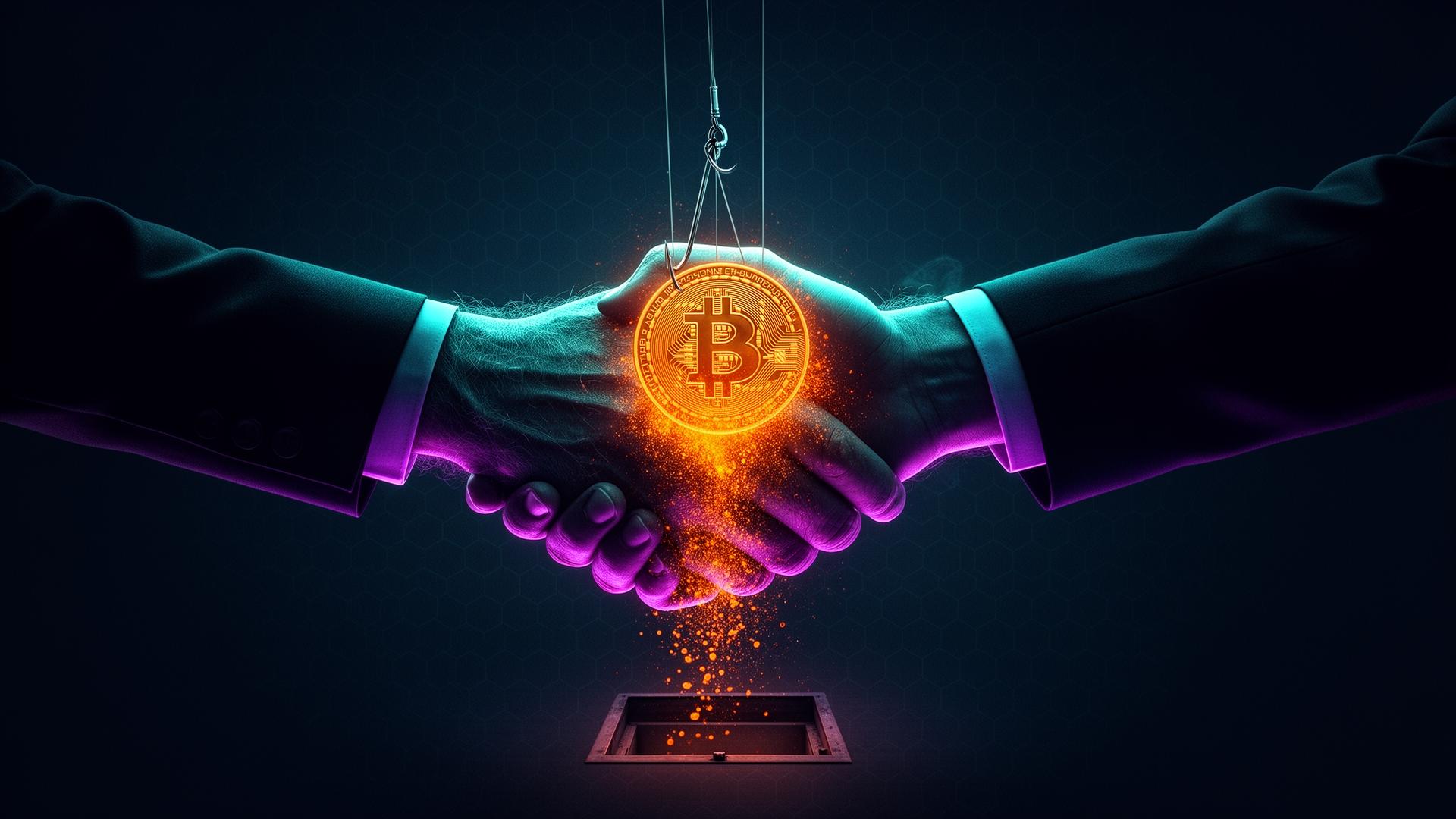
5,000 BTC Handshake Scam: The "7.77 USDT Test"
$450 million. In a Telegram group. Waiting for you.
They promise 5,000 BTC at 5% off. All you need is a "7.77 USDT handshake" to "verify" the deal. Then comes the real Bitcoin — except it never comes. Because it never existed.
The Scheme
Scammers claim to have 5,000 BTC across multiple wallets — that's roughly $450 million. To "verify" you're serious, they ask for a 7.77 USDT "handshake payment." That tiny amount opens the door to escalating fees: insurance, verification, blockchain confirmation. The Bitcoin never arrives.
Handshake protocol. Zero-sum outcome.
Case File Update
Re-traced the fee-collection pattern: the 7.77 USDT 'handshake fee' amount has since been rotated to other odd-numbered figures to dodge pattern matching. Added the generalised rule that beats every variant.
Earlier history
- First published with the three-victim loss reconstruction totalling $333K.
OTC Fraud Investigation Series
This is Part 4 of 5 in our chronological investigation into cryptocurrency OTC fraud. Each story builds on the previous — exposing how the same criminal playbook evolves from bait to trap.
Follow the scam from origin to execution:
Part 1
Black Bitcoin
The Bait: "Discounted" BTC
Where it all starts: the promise of cheap crypto
Part 2
Rip-Deal 2.0
Physical Cash Trap
The setup: fake buyers lure you to "safe" locations
Part 3
100 BTC Sale Scam
The AB Test Fraud
The mechanics: how fake sellers steal your crypto
Part 5
The Staking Deposit
Document-Based BTC Offer Analysis
The follow-up: payment afterwards, custody exposure beforehand
The Hard Truth
Nobody — not one person on this planet — is selling $450 million in Bitcoin through Telegram. Not at a discount. Not for any reason. If you believe this offer, you're not buying crypto — you're funding someone's retirement.
This is the same advance-fee fraud that's been running since email was invented. The Prince of Nigeria got a MetaMask wallet. That's the only thing that changed.
The 7.77 USDT "handshake" sounds trivial. That's by design. It's not about $7 — it's about proving you'll pay. Once you do, the requests never stop.
The Anatomy of This Scam
This OTC scam targets high-net-worth buyers looking for large Bitcoin volumes at discount rates. Scammers present detailed "procedures" with specific requirements: cold wallets, transaction limits, verification windows, and most critically — a small "handshake" payment that supposedly insures the deal.
The 7.77 USDT is just the door fee. Once you pay it, you've proven you're willing to send money on faith. More fees follow. They always do.
Americans lost $9.3 billion to crypto scams in 2024 according to the FBI. This variant uses psychological anchoring: the tiny "test" payment seems absurd compared to 5,000 BTC. That's the point. It makes you rationalize sending it.
The handshake isn't verification. It's qualification — for being robbed.
Scammer Vocabulary Decoded
They use fake professional terms to make you feel like an outsider. Here's what each actually means:
"7.77 USDT Handshake"
What it sounds like:
A small good-faith payment to prove you're serious about a large transaction.
What it actually is:
Your entrance fee to a scam. The specific number (7.77) creates false precision. It's the first of many payments. None are refundable.
"Satoshi Test"
What it sounds like:
A technical verification named after Bitcoin's creator — sounds authoritative.
What it actually is:
Pure invention. There is no "Satoshi test" in Bitcoin. They made it up because it sounds like blockchain wizardry. Real transactions need signatures, not magic words.
"Wallet Registration with Insurer"
What it sounds like:
An insurance company registers your wallet for protection before the transfer.
What it actually is:
Doesn't exist. Crypto insurance (Coincover, Nexus Mutual) covers exchanges, not random wallets. No insurer "registers" buyer wallets. This is theater designed to justify collecting a deposit.
"Cold Wallet Only"
What it sounds like:
Security requirement — cold wallets are safer for large amounts.
What it actually is:
Exclusion tactic. By requiring cold wallets with "max 200 transactions," they filter for inexperienced users who won't recognize the scam. Experienced traders are too dangerous to scam.
"2-Hour Verification Window"
What it sounds like:
A time-sensitive step in a professional transaction process.
What it actually is:
Manufactured urgency. The deadline prevents you from researching, consulting others, or thinking clearly. When you're rushing, you don't verify.
"Intermediary Commission (2%)"
What it sounds like:
Standard fee split among brokers facilitating the deal.
What it actually is:
Fiction designed to suggest a network of professionals. Real OTC desks don't have "intermediaries" cold-messaging on Telegram. The commission structure exists to make the scam look institutional.
Every term sounds like finance. Every one is fiction.
How They Find You
The scam doesn't start with "Want to buy cheap Bitcoin?" That would be too obvious. It starts with you.
You Post First
Someone joins an OTC Telegram group, WhatsApp community, or crypto forum asking "Looking for large BTC volume" or "Need discount seller." Within hours, the DMs arrive. Professional. Patient. Ready to help.
The fish announced it's hungry. The fishermen showed up.
The Referral Chain
A friend-of-a-friend knows "someone with connections." That someone has a client. The client has 5,000 BTC. And for reasons that never quite make sense, they need to sell quietly — at a discount.
Quiet sales. Discount prices. That's definitely how $450 million works.
The Cold Outreach
Less common but bolder: unsolicited messages offering Bitcoin at 5% below market. The sender represents a "mining syndicate" or "liquidating fund." They chose you specifically because... well, they never explain.
You were chosen because you exist. That's the entire criteria.
Real Scam Messages
These are actual messages from this operation, intercepted from Russian-language Telegram channels. The grammar errors are theirs. Study them carefully — this is exactly what the bait looks like:
"Is your buyer ready to work now, or let them name the readiness deadline from the moment of wallet registration by the insurer. For the AB test, 2-3 hours of buyer availability is required for its completion. After its positive result, the seller immediately sends 5,000 BTC."
Translation: We need you invested before you start thinking.
Notice the invented terminology: "AB test," "insurer registration," "positive result." None of these exist in Bitcoin transactions. They're designed to make you feel like you're entering a sophisticated institutional process — one where asking basic questions makes you look amateur.
"Handshake (HS): Buyer sends exactly 7.77 USDT as a unique verification amount. Screenshot required as deal insurance. After receiving the handshake, seller transfers 1-50 BTC in the first transaction."
Translation: Send us $7. Then we'll ask for more.
The "exactly 7.77 USDT" creates false precision — it sounds calculated, professional. The screenshot "for insurance" builds a fake paper trail. The promise of "1-50 BTC" after verification is the carrot. It never arrives.
"Buyer's USDT wallet must hold at least 10 million USDT. Wallet must be cold or hot (NOT exchange-based). Maximum 200 total transactions on the wallet."
Translation: We only want marks who look rich and won't recognize the scam.
These requirements filter victims. "10 million USDT" targets high-net-worth individuals. "Not exchange-based" excludes experienced traders. "Max 200 transactions" ensures the wallet holder is relatively new to crypto. It's a qualification funnel for the perfect victim.
"5% total discount offered. 3% goes to buyer as discount. 2% split between intermediaries. If these conditions are acceptable, we're ready to proceed. If you disagree with the procedure, further discussion and the transaction are suspended."
Translation: Take the deal or leave. We don't want you thinking.
The "2% for intermediaries" suggests a professional network. The ultimatum ("agree or we're done") creates artificial pressure. Real OTC desks negotiate. Scammers don't — because negotiation means scrutiny, and scrutiny kills the scam.
"After 6 blockchain confirmations, buyer must send full USDT payment within 2 hours. Seller conducts Satoshi tests or A/B tests as part of standard verification procedures."
Translation: The procedure never ends until your wallet does.
"6 blockchain confirmations" sounds technical. "2-hour deadline" sounds professional. "Satoshi tests" sounds authoritative. Every term is designed to make you feel like you're in a real process. You're not. You're in a script.
"Your agreement serves as confirmation of accepting the terms. Once handshake is received, process begins immediately. No refunds on verification fees."
Translation: Once you pay, you belong to us.
"No refunds" buried at the end. This is the only honest sentence in the entire script. Everything else is fiction. This is fact.
Red Flags
- •"5,000 BTC available" — That's $450+ million at current prices. Sitting in a Telegram group. Waiting for you. Sure.
- •Wallet restrictions — "Max 200 transactions," "not exchange-based" — rules designed to exclude anyone who'd recognize the scam immediately.
- •"7.77 USDT handshake" — The specific amount sounds precise. Professional, even. It's neither. It's your first payment. The first of many.
- •"Satoshi tests" and "A/B tests" — Fabricated jargon. Made-up procedures. Real Bitcoin transactions don't require magic words.
- •Screenshot requirements — Legitimate trades don't need your screenshots for "proof." This is about building a false paper trail.
- •Ultimatum language — "Agree or we're done" isn't negotiation. It's a countdown. They need you to decide before you think.
- •Intermediary commissions — The "2% for intermediaries" suggests a network of co-conspirators, adding false institutional legitimacy.
Any single flag would be enough. They brought the entire parade.
The Math That Should Have Stopped You
Let's run the numbers on why this deal makes no sense:
The "Discount" Problem
5,000 BTC at 5% below market = ~$22.5 million "discount." Why would anyone give you $22.5 million? Answer: They're not. They're taking your $7 handshake, then your $5,000 insurance, then your $25,000 verification fee.
The Volume Problem
5,000 BTC is ~$450 million. Sellers with this volume use Goldman Sachs, not Telegram. They have Bloomberg terminals, compliance teams, and prime brokerage accounts. They don't need strangers from chat apps.
The Anonymity Problem
Real large-volume sellers have AML obligations. They can't sell to anonymous Telegram contacts. If someone is willing to skip compliance, they're either criminals or scammers. Usually both.
How This Scam Actually Works
The scam follows a predictable five-phase pattern. Each phase sounds professional. None of them are real.
Phase 1: The Approach
They find you in OTC groups, forums, or DMs. They're "intermediaries" for wealthy Bitcoin holders looking to liquidate at discount rates. The story sounds too good. It's designed to.
You're not being recruited. You're being qualified.
Phase 2: The Paperwork Theater
Wallet requirements. Transaction limits. Verification steps. The complexity is intentional. Victims assume only legitimate deals would be this bureaucratic. They're wrong.
Complexity is camouflage. Not security.
Phase 3: The Hook
The 7.77 USDT "test" seems laughable next to 5,000 BTC. Victims rationalize: "It's less than $10 — what's the risk?" The risk is everything. Because that first payment proves you'll pay. And they're not done asking.
The handshake is the audition. You passed. Now the real show begins.
Phase 4: The Escalation
New "requirements" materialize. Insurance deposits. Verification fees. Blockchain confirmation fees. Each request is small compared to 5,000 BTC. That's by design.
This phase repeats until you run out of money or faith.
Phase 5: The Vanishing
Eventually they demand an amount you won't pay. Or they simply disappear. The Bitcoin never arrives. It was never going to. The fees? Gone. The scammers? On to the next handshake.
This phase has never failed. Not once.
Real Cases
These aren't hypotheticals. These are documented patterns.
Three profiles. Three reasons. One outcome: money gone, Bitcoin never received. The scam doesn't discriminate. It finds the gap between "I know enough" and "I know enough to verify." That gap cost these people everything.
The Mining CEO ($85,000)
A mining operation owner looking to expand holdings received an "exclusive offer" from an "OTC syndicate." Over two months, he paid handshake fees, insurance deposits, and "expedited verification." The final ask was $50,000 for "international transfer clearance." He walked away. By then, $85,000 was gone.
"I run a mining operation. I thought I knew this space. Turns out I knew the technology — not the scams."
The Fund Manager ($230,000)
A boutique crypto fund manager was offered 5,000 BTC for a client portfolio. The "seller" had documentation, references, and a detailed procedure. Over three months, the fund paid cascading fees. When the client demanded answers, the manager discovered the seller's LinkedIn was fake.
"The documentation looked real. The references checked out — because they were part of the operation too."
The Early Adopter ($18,000)
A 2013 Bitcoin buyer wanted to increase his holdings. The 7.77 USDT handshake seemed trivial. Two weeks later, he'd paid $18,000 in various "verification" fees. He stopped when they asked for $40,000 more.
"I've been in crypto for a decade. I watched every bubble, every crash. I still fell for this."
Profiles are composites based on documented attack patterns, not individual victims.
Why Smart People Fall For It
The victims aren't stupid. They're optimistic. There's a difference.
The Discount Illusion
5% off $450 million sounds like a once-in-a-lifetime deal. The brain calculates potential profit and stops asking why the deal exists. Greed overrides logic.
Complexity as Legitimacy
Satoshi tests, AB tests, insurer registrations — the complexity feels institutional. Victims assume only real deals would be this complicated. The truth is opposite: complexity is how scams hide.
Manufactured Urgency
"2-hour verification window" prevents careful consideration. When you're rushing, you don't verify. When you don't verify, you pay.
The Sunk Cost Trap
After the 7.77 USDT handshake, victims pay more to "complete the process" rather than admitting they've been scammed. Each payment feels like protecting the previous one.
This doesn't require stupidity. Just hope. Just timing. Just one moment of "what if this is real?"
How to Protect Yourself
There are five rules. They will save you every time.
- Rule 1: Never pay "handshake" fees No legitimate seller requires small advance payments to "prove" you're serious. The 7.77 USDT is a trap, not a test.
- Rule 2: Question "below-market" rates Nobody sells $450 million in Bitcoin at a discount to strangers. If the math seems too good, it's because the math is fake.
- Rule 3: Use regulated OTC desks For large transactions, work with licensed providers: Kraken OTC, Coinbase Prime, Cumberland, Circle Trade. Real companies. Real compliance. Real escrow.
- Rule 4: Verify everything Real institutional sellers have corporate registrations, verified LinkedIn profiles, and public track records. If you can't find them on Google, they don't exist.
- Rule 5: Ignore ultimatums "Accept now or we're done" is a pressure tactic, not a business practice. Legitimate sellers don't vanish if you take a day to verify.
Think You Can Spot a Scam?
Test your knowledge with real scam scenarios from our investigations.
Got a Suspicious Message?
Use our AI-powered detector to analyze potential scams instantly.
Key Takeaways
- 1.The 7.77 USDT handshake is classic advance-fee fraud. It's never about $7 — it's about proving you'll pay.
- 2.5,000 BTC at discount rates from Telegram contacts is a mathematical impossibility. Question any deal that sounds too good.
- 3."Satoshi tests" and "AB tests" are made-up terminology. Real OTC trades don't require magic words.
- 4.Complexity is camouflage, not security. If a procedure seems too elaborate, it's designed to overwhelm your judgment.
- 5.Once you've paid the handshake, escalating fees are inevitable. The only winning move is not to shake.
- 6.The victims aren't stupid — they're hopeful. That's what the scam exploits.
“The handshake was real.”
The deal wasn't.
Frequently Asked Questions
Sources & Citations
Research for this investigation compiled from publicly available blockchain data, security reports, and community documentation.
thehackernews.com · Date not published or not verified
Cointelegraph · 24 Apr 2025
www.ic3.gov · Date not published or not verified
Verification: On-chain references: none published for this case.
Methodology: Every case needs at least two independent sources before publication, plus verifiable on-chain evidence whenever a public transaction trail exists. Full standards: /methodology
Legal notice: This assessment is based on publicly available data, including on-chain records, official statements and reported incidents. It is journalistic and educational analysis, not legal advice, an accusation of criminal conduct or a court finding. Named companies, projects, domains, wallets and individuals are described as reported by the cited sources; a company name may appear because fraudsters impersonated it, not because the company did anything wrong. If you believe something is inaccurate or out of date, write to cryptostrapon@pm.me and we will correct it and log the change. Editorial policy