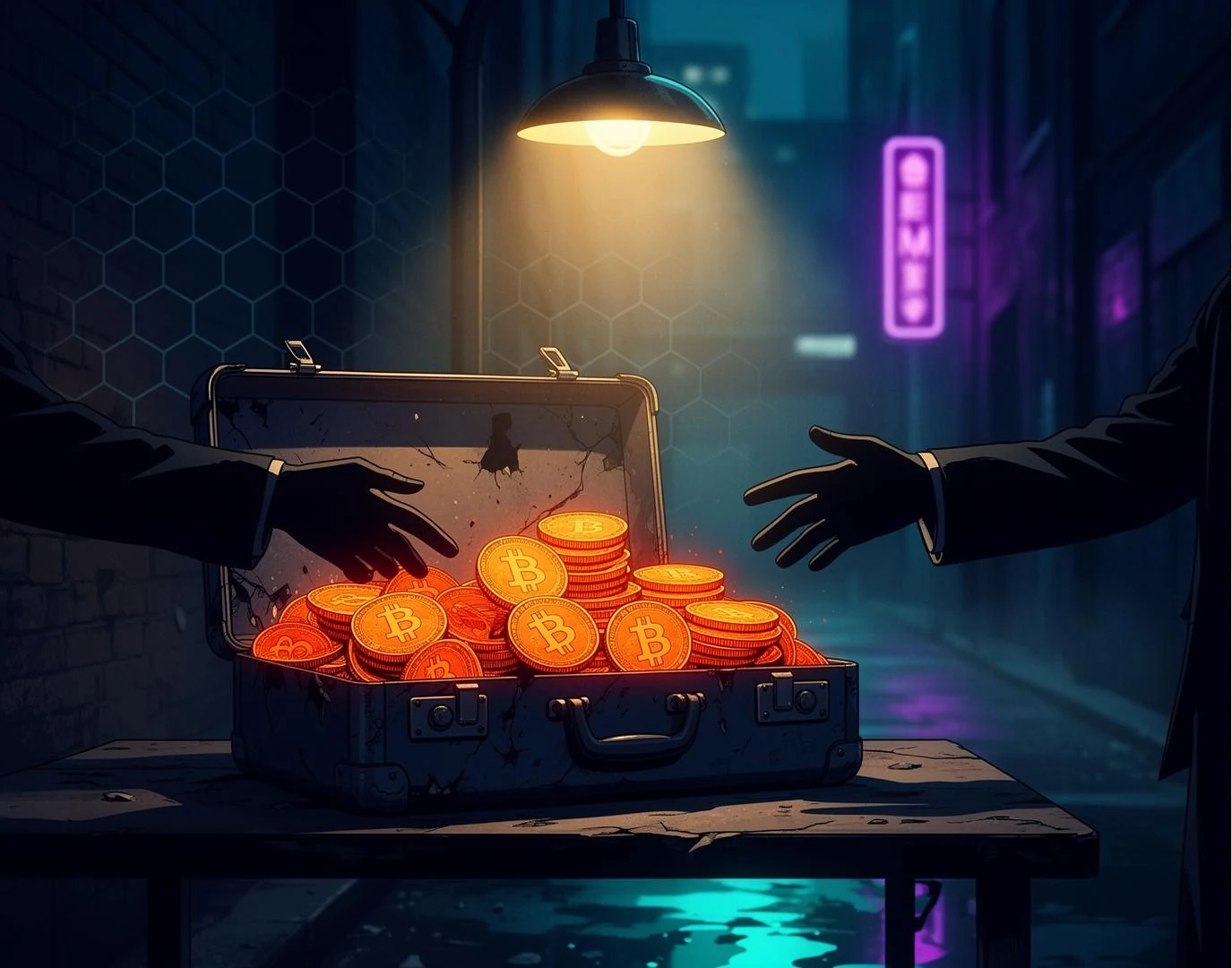
In-Person Bitcoin-for-Cash Scams: How 'Rip-Deals 2.0' Work
Real cash. Counterfeit cash. Hidden cameras on your wallet.
Austrian police call it "Rip-Deal 2.0": a buyer offers a premium for your Bitcoin, meets you in person with a stack of cash — and the cash is counterfeit, or a hidden camera has already captured your wallet details. In December 2024, Vienna police arrested a 39-year-old in Milan over a scheme that cost victims EUR 1.2 million. The unit says it has solved over 100 related cases worth about EUR 25 million since 2020.
The Scheme
You want to sell Bitcoin for cash. A "buyer" offers a premium and arranges an in-person meeting. What happens next is what Austrian police call a "Rip-Deal 2.0": the cash handed over is counterfeit, or a hidden camera records your wallet details during a staged "verification" step, or an accomplice swaps the bag the moment you look away. Some reports describe elaborate dressing — fake safe houses, bundles of paperwork — but those specific props vary case by case and aren't individually confirmed; the pattern that is documented is the swap itself.
The only thing verified is your naivety.
Case File Update
Removed the unverified 'Vienna safe house / 21 documents' detail as an established fact; the page is now based on documented Rip-Deal 2.0 police cases, with the original narrative kept only as a reported, unverified scenario.
OTC Fraud Investigation Series
This is Part 2 of 5 in our chronological investigation into cryptocurrency OTC fraud. Each story builds on the previous — exposing how the same criminal playbook evolves from bait to trap.
Follow the scam from origin to execution:
Part 1
Black Bitcoin
The Bait: "Discounted" BTC
Where it all starts: the promise of cheap crypto
Part 2
Rip-Deal 2.0
Physical Cash Trap
The setup: fake buyers lure you to "safe" locations
Part 3
100 BTC Sale Scam
The AB Test Fraud
The mechanics: how fake sellers steal your crypto
Part 4
5,000 BTC Handshake
The "7.77 USDT Test"
The endgame: advance-fee fraud at scale
Part 5
The Staking Deposit
Document-Based BTC Offer Analysis
The follow-up: payment afterwards, custody exposure beforehand
Scammers recycle the same playbook with fake USDT transfers (Flash USDT scam) — same theater, different chip.
The Hard Truth
Nobody pays 10% above market for your Bitcoin. Not today. Not ever. If a "buyer" approaches you with this offer, they're not buying — they're collecting. And what they're collecting is your money.
This scam targets Bitcoin whales looking to exit through OTC deals. The more you have, the more appealing you are. The elaborate procedures — safe houses, document pallets, verification tests — exist to make you stop thinking and start hoping.
The "Vienna Safe House" is the crypto equivalent of meeting a stranger in an alley with a suitcase of cash. Except the alley is digital, and the suitcase is empty.
The Anatomy of This Scam
This scam inverts the typical advance-fee fraud. Instead of offering discounted Bitcoin, scammers pose as wealthy buyers offering premium prices. They create elaborate procedures involving physical locations, multiple verification steps, and fake institutional backing.
The goal is always the same: extract payment before any Bitcoin changes hands. The payment is called an "AB test," "verification deposit," or "insurance fee." It's none of those things.
Vienna's cybercrime unit says it has solved over 100 related cases worth about EUR 25 million since 2020. A similar scheme surfaced in Hong Kong in 2024, where sellers were paid in counterfeit notes for USDT. In July 2025 the same Vienna unit was still hunting a suspect who took 40 BTC from sellers after meetings in Malaga and Paris.
The more details they provide, the less truth exists.
Scammer Vocabulary Decoded
They dress their lies in professional clothing. Here's what each term actually means:
"Safe House"
What it sounds like:
A secure, private location where large cash transactions occur away from public eyes. Professional. Discreet.
What it actually is:
A fictional address. Real large-cash transactions happen at banks with armored transport, not mysterious houses. If someone offers to meet at a "safe house," they're planning to take your Bitcoin, not give you euros.
"21-Document Pallet"
What it sounds like:
Serious institutional documentation — legal papers, certificates, compliance documents arranged on cash pallets.
What it actually is:
Complete fiction. No such standard exists. They invented 21 documents to overwhelm you: "FED confirmation," "Ministry of Treasure" (not real), "cipher codes." The number is specific because specificity sounds credible.
"AB Test"
What it sounds like:
A verification procedure where you prove wallet ownership by completing a test transaction.
What it actually is:
The extraction mechanism. Your blockchain balance is publicly visible — anyone can verify you own coins without moving them. The "test" is purely to collect your Bitcoin before vanishing.
"Buyer Verification Window"
What it sounds like:
A 2-3 hour availability requirement where both parties confirm transaction details.
What it actually is:
Manufactured pressure. Real OTC deals don't have "windows." The tight timeframe prevents you from consulting advisors, researching, or thinking clearly.
"Insurer Registration"
What it sounds like:
Your wallet being registered with an insurance company for transaction protection.
What it actually is:
Doesn't exist. Crypto insurers (Coincover, Nexus Mutual) insure exchanges and custodians, not individual wallets. No "registration" process exists for OTC sales.
"Positive Result"
What it sounds like:
Successful completion of verification, after which the transaction proceeds.
What it actually is:
The moment your test Bitcoin arrives in their wallet. That's the only "result" they need. Everything promised after is fiction.
Every procedure sounds institutional. None of them exist. That's the entire architecture.
How They Find You
You don't find them. They find you. Here's how.
You Announce Intent
You post in a crypto forum, Telegram group, or LinkedIn: "Looking to sell large BTC position OTC" or "Need cash buyer for crypto." Within hours, the "buyers" arrive. Professional. Connected. Ready.
The sheep announces it's carrying gold. The wolves take notes.
The Warm Introduction
A mutual contact mentions they know "someone serious." A fund. A family office. Someone with "euro liquidity" looking for Bitcoin. You're introduced. Everything seems legitimate.
The contact may be complicit. Or simply fooled like you're about to be.
The Direct Approach
Less common: cold outreach claiming to represent a buyer consortium. They've "identified you" as a potential seller. They want to discuss "a mutually beneficial arrangement."
You were identified because you exist online.
Real Scam Messages
These illustrative examples show the kind of elaborate scripts reported in this scam pattern — they are not a verified transcript from one specific case. If you receive anything similar, stop immediately:
"Dear Gentlemen, Procedure for purchasing BTC for cash. The procedure is based on a 10% bonus for cash payments, specifically +6%/+2%/+2% (Buyer and Seller side). The buyer requires the seller to provide a BTC wallet with a minimum balance of 5,000 BTC or more and a maximum of 100 transactions for verification."
Translation: We're looking for whales to extract from. The bonus is bait.
Notice the specific percentages (6%/2%/2%) — they create an illusion of institutional precision. The 5,000 BTC minimum ($500M+) filters for high-value targets worth the elaborate setup.
"Is your seller ready to work now, or let them name the readiness deadline from the moment of wallet registration by the insurer. For the AB test, 2-3 hours of buyer availability is required for its completion. After its positive result, the buyer immediately sends euros."
Translation: Send us Bitcoin. We'll send you nothing.
The "2-3 hour window" creates manufactured urgency. "Positive result" sounds like a verification outcome, but it means "your Bitcoin has arrived in our wallet."
"The euro pallets are prepared at our Vienna security facility with full documentation. 21 documents accompany each pallet: FED confirmation, Ministry of Treasure certification, cipher for removing the security code, QR code for bank scanner verification. All ready for immediate pickup."
Translation: None of this exists. Not one word.
"Ministry of Treasure" — not a real thing. "Cipher for removing the security code" — meaningless jargon. "QR code for bank scanner" — banks don't use QR codes on cash. Every detail is designed to overwhelm with fake specificity.
"We require confirmation within 72 hours to organize the euro pallets and reserve the safe house. Our buyer has other sellers on standby. Time-sensitive opportunity. Please confirm seller readiness."
Translation: Decide before you can think. That's the whole plan.
72 hours is long enough to seem reasonable, short enough to prevent proper due diligence. "Other sellers on standby" is manufactured competition — FOMO weaponized.
"Before we proceed with the meeting, the insurance partner requires a verification deposit of 0.5 BTC. This confirms wallet ownership and will be returned immediately after the AB test completion. Standard OTC procedure."
Translation: This is where your Bitcoin becomes their Bitcoin.
0.5 BTC (~$50,000) seems small compared to the promised millions. That's the calculation. "Standard OTC procedure" is the cherry on top — it's not standard, and real OTC desks never ask for deposits.
Red Flags
"10% above market price"— Why would anyone pay more? They wouldn't. Real OTC buyers negotiate discounts of 1-3%, not bonuses. A premium offer is a neon sign saying "scam."
"Vienna safe house"— Legitimate large-cash transactions happen at banks with armored transport, compliance officers, and AML verification. Not mysterious European addresses.
"21 official documents"— Invented bureaucracy. No such documentation standard exists in crypto or traditional finance. The specific number is designed to sound thorough.
"AB test" before payment— Your balance is publicly visible on the blockchain. Any "proof of ownership" requiring a transfer is theft in disguise.
"72-hour deadline"— Artificial pressure. Real institutional buyers don't work on ultimatums — they work on due diligence. Time limits exist to prevent yours.
"Insurance partner deposit"— No such thing. Crypto insurance doesn't work this way. The "partner" is a wallet address the scammer controls.
Contact via Telegram/email— Real OTC desks (Kraken, Cumberland, Circle) don't source sellers through messaging apps. They have Bloomberg terminals and compliance teams.
They didn't forget any red flags. They brought the complete collection.
The Math That Should Have Stopped You
Let's examine why this deal collapses under basic arithmetic:
Five steps. Each one sounds professional. None of them are real.
Step 1: Target Identification
Scammers monitor crypto forums, Telegram groups, and LinkedIn for sellers announcing large positions. High-net-worth targets are prioritized. The more you have, the more elaborate the script.
This is just market research. For criminals.
Step 2: Building the Fantasy
They introduce the Vienna safe house, euro pallets, 21 documents, and institutional language. NDAs are mentioned. Legal teams are referenced. Everything screams legitimacy.
This is where skepticism dies and hope takes over.
Step 3: The Verification Trap
Before the face-to-face meeting, they need "wallet verification" via an AB test. Send a small amount — 0.1, 0.5, or 1 BTC — to prove ownership. The amount feels negligible compared to the promised payout.
This is the only step that matters. Everything else is decoration.
Step 4: The Escalation
Test sent? There's another requirement. "Compliance delay." "Insurance verification extended." Each new fee is smaller than the promised payout, so you keep paying. Sunk cost psychology takes hold.
This step loops until you run out of money or trust.
Step 5: Disappearance
When extraction is complete — or you stop paying — they vanish. Telegram deleted. Email bounces. The safe house address leads nowhere. The euros never existed.
This step has a 100% execution rate.
Victim Profiles
These profiles are composites based on patterns reported to European cybercrime units and crypto fraud investigators. Names changed. Details merged. The psychology is real.
Profile A: Early Adopter, No OTC Trading Background
A composite account, reflecting a reported pattern rather than one verified victim: a software developer who had never traded OTC before, approached by "buyers" offering a premium above market. He had no baseline for what a normal OTC deal looks like, which is exactly what this scam pattern exploits.
"I build software. I know tech. But I'd never sold this much before. Their process seemed... thorough."
Profile B: Inheritance Recipient, Zero Crypto Experience
Another composite pattern: someone who inherited a hardware wallet with no prior crypto knowledge, found "buyers" through a Telegram group, and was walked through a fabricated verification process by people who seemed like the only ones willing to explain anything.
"I didn't even know what a seed phrase was. They seemed so helpful. They were the only people who answered my questions."
Profile C: Business Owner, Privacy Motivation
A third composite pattern: someone wanting discretion around a large crypto liquidation accepted unusual procedures — NDAs, "privacy protocols," an insistence on an in-person cash meeting — because the need for secrecy made every red flag easier to rationalize.
"I couldn't tell anyone what I was doing. That's exactly what they counted on."
Profiles are composites based on documented attack patterns, not individual victims.
Why Smart People Fall For It
These victims weren't careless. They were hopeful. And hope has its own logic.
The Premium Illusion
When someone offers above market price, the brain calculates potential profit and stops asking why the deal exists. The premium blinds you to the impossibility.
Institutional Complexity
Safe houses, document pallets, insurance registrations — it sounds like serious business. Victims assume scammers wouldn't invest this much effort. The effort IS the product.
Manufactured Urgency
"72 hours" and "other buyers" create pressure that prevents verification. When you're rushing, due diligence becomes inconvenient.
The Sunk Cost Spiral
After paying initial fees, victims pay more to "complete the process." Walking away means admitting loss. Paying more preserves the dream.
Intelligence doesn't protect you. Hope does the damage. Just one moment of "this could be real" is all they need.
How to Protect Yourself
Five rules. They will save you from this and every variant.
Rule 1: Reject above-market offers
If someone pays more than market price, they're not a buyer. Real OTC buyers negotiate discounts. Premiums don't exist in legitimate transactions.
Rule 2: Never send "verification" transfers
Your blockchain balance is public. Anyone can verify ownership without you moving a single satoshi. If they need you to send coins, they're stealing them.
Rule 3: Use regulated OTC desks only
Kraken OTC, Coinbase Prime, Cumberland, Circle Trade, Galaxy Digital. These are real companies with compliance teams, track records, and legal accountability. Use them.
Rule 4: Verify the buyer exists
Real institutional buyers have company registrations, LinkedIn profiles, Bloomberg presence, and verifiable history. If you can't find them in 10 minutes of research, they don't exist.
Rule 5: Time is your friend
Legitimate buyers don't disappear if you take a week to verify. Urgency is a scam indicator. Due diligence takes time. Take it.
Think You Can Spot a Scam?
Test your knowledge with real scam scenarios from our investigations.
Got a Suspicious Message?
Use our AI-powered detector to analyze potential scams instantly.
Key Takeaways
- 1.Premium offers for Bitcoin are always scams. Real buyers negotiate discounts, not bonuses.
- 2.Safe houses, document pallets, and AB tests are fictional procedures. They don't exist anywhere in legitimate crypto trading.
- 3.Any request for upfront payment — deposits, fees, "insurance" — is theft. Legitimate deals don't require you to pay first.
- 4.Contact via Telegram or email is a red flag. Real OTC desks have institutional channels, not messaging apps.
- 5.The complexity is the weapon. The more elaborate the procedure, the more certain you should be it's fake.
- 6.If the deal seems too good, run the numbers on why someone would give you that money. They wouldn't.
“The safe house was real.”
The safety wasn't.
Frequently Asked Questions
Sources & Citations
Research for this investigation compiled from publicly available blockchain data, security reports, and community documentation.
Decrypt · 17 Dec 2024
VIENNA.AT · 12 Dec 2024
ORF Wien · 12 Dec 2024
ORF Wien · 17 Jul 2025
OOeNachrichten · 17 Jul 2025
crypto.news · 3 Jun 2024
Verification: On-chain references: none published for this case.
Methodology: Every case needs at least two independent sources before publication, plus verifiable on-chain evidence whenever a public transaction trail exists. Full standards: /methodology
Legal notice: This assessment is based on publicly available data, including on-chain records, official statements and reported incidents. It is journalistic and educational analysis, not legal advice, an accusation of criminal conduct or a court finding. Named companies, projects, domains, wallets and individuals are described as reported by the cited sources; a company name may appear because fraudsters impersonated it, not because the company did anything wrong. If you believe something is inaccurate or out of date, write to cryptostrapon@pm.me and we will correct it and log the change. Editorial policy