The Letter in Your Mailbox: How Scammers Use Physical Mail to Steal Crypto
Scan the QR code. Lose everything.
They have your home address from the 2020 data breach. Now they're sending official-looking letters with QR codes. Scan it, and your seed phrase goes straight to them.
The Scheme
Physical letters arrive claiming to be from Ledger. They reference "security incidents" and demand "immediate wallet verification." Inside: a QR code. Scan it, enter your seed phrase on the fake site, and watch your crypto disappear in seconds.
Analog attack. Digital theft.
Does Ledger Ever Ask for Your Seed Phrase?
No. Never. Not in a letter, not by email, not in Ledger Live, not in a support chat, not over the phone.
Your 24 words exist so that you — and only you — can restore your wallet. Ledger has no use for them and no way to verify them. That is why the rule has no exceptions: anything that asks you to type, scan, photograph or "validate" your recovery phrase is a theft attempt, whatever logo it carries.
- Ledger does not mail unsolicited letters telling you to verify or migrate your wallet.
- A QR code in a letter is not verification — it is a link you cannot read before you open it.
- Your address is in a scammer's spreadsheet because of the 2020 customer-data leak, not because Ledger contacted you.
One test settles every case: if it wants the 24 words, it is a scam.
The Hard Truth
In July 2020, Ledger's e-commerce database was breached. Not the hardware — the customer database. About 1 million email addresses were exposed, and a later data dump tied to the incident contained about 272,000 customer records, with roughly 9,500 of those including full names and home addresses (Ledger, Jul–Dec 2020).
If you bought a Ledger before the breach and used your real address, scammers now have it. They know you own crypto. They know you have a hardware wallet. And they know where you live.
This isn't random spam. These letters are targeted at confirmed hardware wallet owners. The scammers have done their homework.
The Anatomy of This Attack
Physical mail feels legitimate. That's the trap. Unlike email, which we've learned to distrust, a letter arriving at your home address feels official. It has weight. It has texture. It feels real.
The letter looks exactly like official Ledger correspondence. Same fonts. Same branding. Same official tone.
But inside is a QR code that leads to a phishing site — an exact clone of Ledger's verification page. Enter your seed phrase there, and automated scripts drain your wallet in seconds.
Paper doesn't make it real. It makes you trust it.
Vocabulary, Decoded
The letter uses official-sounding terms to create urgency. Here's what each actually means:
"Security Incident"
Sounds like: A legitimate breach at Ledger that affected your specific device.
Reality: Generic fear. They reference "incidents" because it sounds alarming and requires no proof. Ledger announces real security issues through Ledger Live — never via physical mail.
"Wallet Verification Required"
Sounds like: A necessary security step to protect your funds.
Reality: The extraction mechanism. "Verification" means "give us your seed phrase." Ledger will NEVER ask you to verify your wallet by entering your seed phrase. Ever.
"Firmware Update"
Sounds like: A software update to fix vulnerabilities on your device.
Reality: Bait. Real firmware updates happen through Ledger Live, not through QR codes in mail. If a letter tells you to update via QR code, it's designed to steal your seed phrase.
"24-Word Recovery Phrase Entry"
Sounds like: Standard procedure to confirm device ownership.
Reality: The theft itself. Your 24 words are the master key to everything. No legitimate service will ever ask you to type them into a website. Once entered, your crypto is gone.
"CEO Signature"
Sounds like: Official endorsement from Pascal Gauthier himself.
Reality: Copied signature. CEOs don't sign security letters. Anyone can copy a signature from LinkedIn or press releases. It's decoration, not authentication.
"14-Day Deadline"
Sounds like: A compliance window before action is taken.
Reality: Manufactured urgency. The deadline exists to prevent you from thinking. There's no countdown on your actual wallet. Scammers want you panicked, not careful.
Every term sounds official. None of them are real. That's the entire trick.
How They Find You
This scam doesn't start with a random letter. It starts with data that shouldn't exist.
The 2020 Breach
Ledger's e-commerce database was compromised in 2020. About 1 million email addresses were exposed, and a later dump of roughly 272,000 customer records included full names and physical addresses for about 9,500 people (Ledger).
Your address wasn't stolen. It was purchased.
Targeted Mailing Lists
Scammers don't send letters randomly. They target confirmed Ledger owners — people who definitely have crypto and definitely have a hardware wallet. You're not a random victim. You're a qualified lead.
They know you have a wallet. They want what's in it.
Physical Mail Bypasses Spam Filters
Email scams get caught. Physical mail arrives. There's no spam filter for your mailbox. The letter gets opened because it looks official and feels important.
Your mailbox has no security. That's the vulnerability.
Real Scam Letters
These are actual text examples from intercepted scam letters. The grammar is theirs. The urgency is manufactured. If you receive anything similar, do not follow any instructions:
"LEDGER SECURITY NOTICE — Reference: SEC-2025-0892. Dear Valued Customer, Following the recent security breach affecting Ledger hardware wallets, we have identified that your device may be vulnerable to a critical firmware exploit. To protect your digital assets, scan the QR code below and enter your 24-word recovery phrase for verification."
Translation: We want your seed phrase. We're pretending there's an emergency.
Notice the reference number — it's fake. The "security breach" is vague. The "QR verification" is the trap. Ledger never sends physical security notices.
"From the desk of Pascal Gauthier, CEO. I am writing to personally inform you of an urgent security matter. Your Ledger device requires immediate verification. Please scan the enclosed QR code within 14 days to maintain access to your funds."
Translation: We copied the CEO's name from LinkedIn. The deadline is fake.
CEOs don't write security letters. The personal touch is designed to make you trust it. The 14-day deadline is manufactured pressure. None of it is real.
"CRITICAL: Your Ledger Nano requires firmware update version 2.4.1 to address recently discovered vulnerabilities. Failure to complete this update within 7 days may result in loss of access to your cryptocurrency holdings. Scan QR code to begin secure update process."
Translation: This QR code leads to a phishing site, not a firmware update.
Firmware updates happen through Ledger Live. There's no QR code process. The "loss of access" threat is false — your hardware wallet doesn't expire.
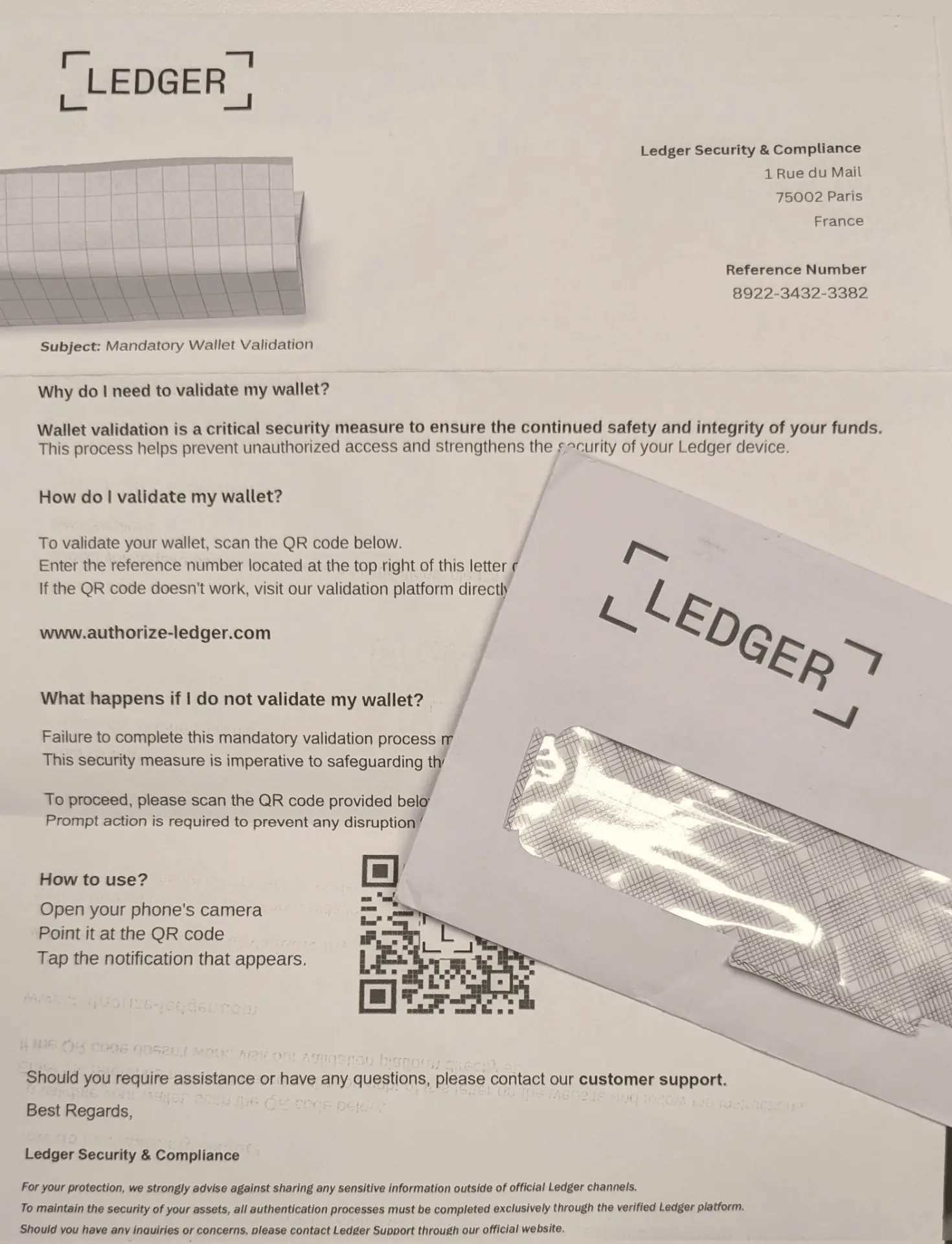
Example of a fake Ledger letter. Note the QR code — it leads to a phishing site.
What's Documented So Far: Tampered Devices and QR-Code Letters
Documented since June 2021 (BleepingComputer): criminals have mailed tampered Ledger Nano X devices, along with a letter, to customers affected by the 2020 leak. The device arrives with an implant and a seed phrase the attacker already knows; any funds moved onto it go straight to them.
Since then, the tactic has evolved into QR-code letters: a fake 'critical security update' notice in April 2025 (Cointelegraph), 'Authentication Check' and 'Transaction Check' letters impersonating Trezor and Ledger in February 2026 (BleepingComputer), and letters in Italy carrying a forged executive signature in May 2026 (HackRead). Ledger also confirmed a January 2026 data exposure at its partner Global-e (The Block).
From Mailbox to Inbox: a Survey Email, a CAPTCHA, and the Same Old Seed-Phrase Grab
The crew got tired of paying for stamps. In October 2026, screenshots shared by a security researcher on X show a Ledger-branded email that doesn't come from Ledger at all — it comes from the no-reply address of Alchemer, a legitimate survey and feedback platform. Translation: the sender is real, the message isn't. A familiar platform in the From line makes the email look more routine than it is — and that's the whole trick.
The button lands on a Ledger-lookalike domain (masked: device.ledger-conf…live, already listed as a phishing indicator by SOC Defenders). First thing you see: a CAPTCHA. "Are you human? Enter the code below to verify." How thoughtful. That bouncer isn't there to protect you — it's there so automated security scanners never get past the door to the seed-phrase form. Bots get a boring screen. You get the full con.
The same screenshots show scan results with more lookalike domains aimed at both Ledger and Trezor users. Nor is it a one-off: on 16 October 2026 Protos reported another Ledger-branded "firmware update" email flagged by SlowMist. We have not verified any collection address or victim losses for this wave, so we are not publishing numbers.
Paper, QR, email, CAPTCHA — the wrapping changes every season. The ending doesn't: a form that wants your 24 words. Ledger says it on its own support page: it will never ask for them.
Trezor in the Mailbox: a Fake Recall Notice and the Skladon Leak
Paper is back, this time with a Trezor logo. A photo posted on X in mid-November 2026 shows an envelope postmarked Tampa/Saint Petersburg, Florida, on 9 November. Inside: an "urgent security recall notice" for the Model One, Safe 7 and Model T, a claimed flaw in the TROPIC01 chip, a signature credited to the CEO and a QR code to "start the replacement". The only thing they plan to replace is the owner of your funds.
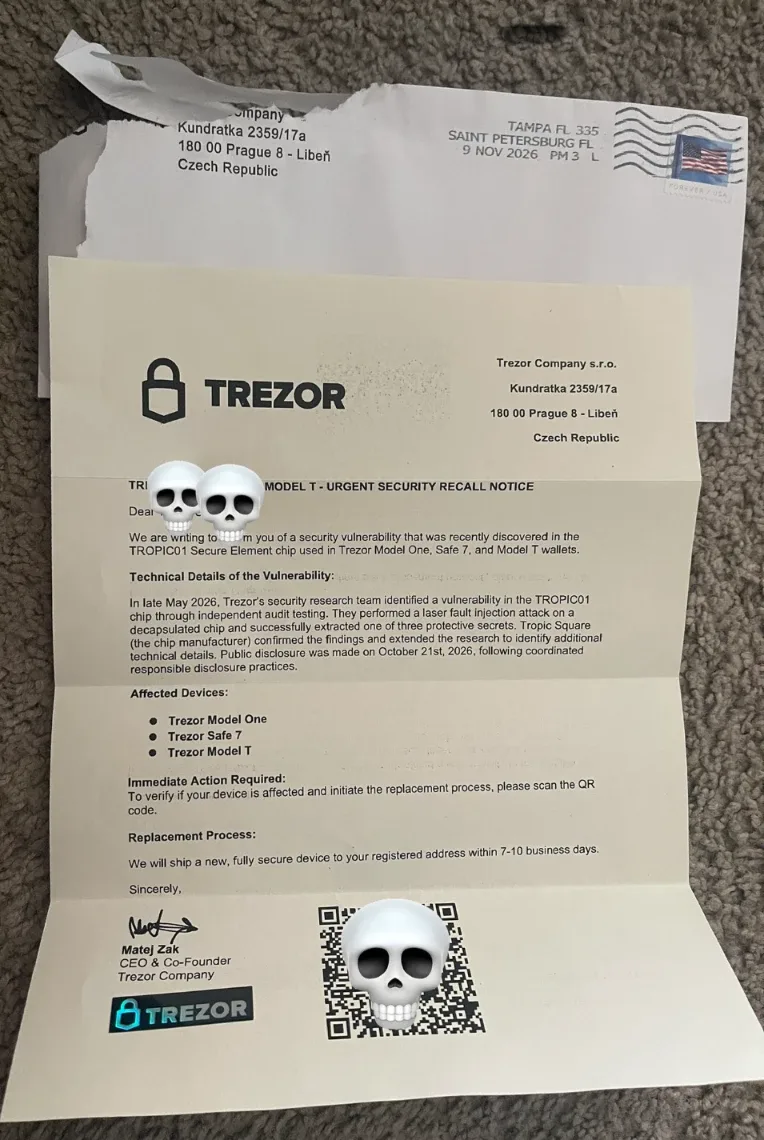
Fake Trezor letter, postmarked 9 November 2026. Personal details and the QR code are covered in the original photo.
Six days later, on 15 November, Trezor said Skladon, one of its delivery partners, had suffered unauthorized access. According to Trezor, data for about 27,000 orders placed between 9 August and 7 November was exported: name, phone number, address, email and order details. Trezor says its own systems and devices were not compromised, and that Skladon does not ship to the US.
Mind the dates. The letter left Florida before the notice, and Skladon does not deliver to the US, so this particular letter does not prove use of the Skladon data. What does change: about 27,000 buyers in other countries now have their address in someone else's hands. Trezor asks customers to treat any unexpected call, text, email or letter about an order as suspicious, and says it never cold-calls or asks for a wallet backup.
A real manufacturer announces problems on its website and in its app. It does not announce them with a QR code in an envelope.
Red Flags
- •Physical mail about crypto security — Ledger never sends physical security notices. All legitimate updates come through Ledger Live only.
- •QR codes in letters — No hardware wallet company sends QR codes via mail. Ever. This is the attack vector.
- •"Enter your 24-word phrase" — This is never legitimate. Your seed phrase should never be typed into any website. Period.
- •Urgent deadlines — "14 days" or "7 days" are manufactured panic. Your wallet doesn't have an expiration date.
- •Reference numbers — Fake case IDs ("SEC-2025-0892") are decoration. Anyone can invent a reference number.
- •CEO signatures — Copied from public sources. Real executives don't sign security correspondence.
- •"Loss of funds" threats — Your funds aren't at risk from ignoring a letter. They're at risk from following its instructions.
One red flag is enough to know. They sent seven.
The Math That Exposes This Scam
Physical mail costs money. That tells you something about the expected payout.
How This Attack Works
The attack is simple. The trust it exploits is not.
Step 1: Letter Arrives
An official-looking envelope appears in your mailbox. It has Ledger branding, professional printing, and references a security issue. It feels important.
The paper is real. The threat isn't.
Step 2: QR Code Scanned
You scan the QR code with your phone. It opens a website that looks exactly like Ledger's official site — same design, same logos, same layout.
The site is cloned. The URL is not.
Step 3: "Verification" Requested
The fake site asks you to "verify" your wallet by entering your 24-word recovery phrase. It explains this is for security. It feels reasonable.
Nothing about entering your seed phrase online is reasonable.
Step 4: Seed Phrase Captured
The moment you submit your seed phrase, scammers have complete control of your wallet. Automated scripts immediately import it into their own wallet software.
There is no undo. There is no customer service.
Step 5: Wallet Drained
Within seconds to minutes, all assets are transferred out. Every address derived from that seed — Bitcoin, Ethereum, everything — is swept to wallets the scammers control.
The blockchain is permanent. So is the loss.
Real Cases
These aren't hypotheticals. These are documented victims.
Three people. Three reasons to trust a letter. Three empty wallets. The attack works because physical mail feels different than email. It shouldn't.
The Early Adopter ($85,000)
Bought his Ledger in 2018. Received a letter referencing the "2020 breach" and requesting "wallet migration." He'd heard about the breach, so the letter seemed plausible. Scanned the QR code, entered his seed phrase. 2.3 BTC gone in under a minute.
"I knew about the breach. That's why I believed the letter was real."
The Careful Investor ($42,000)
She kept her seed phrase in a bank safe deposit box. The letter claimed her "device required verification" to remain secure. She retrieved her seed phrase from the bank and entered it on the phishing site. $42,000 in ETH drained before she closed her browser.
"The website looked exactly like Ledger's. I checked the URL but didn't notice the extra letter."
The Tech Professional ($120,000)
Works in cybersecurity. Received the letter on a busy week. Scanned the QR code on autopilot, entered his seed phrase before realizing the URL was wrong. Lost 4.5 ETH and various tokens across multiple chains.
"I tell people about phishing for a living. I still fell for it because it was paper."
Profiles are composites based on documented attack patterns, not individual victims.
Why Smart People Fall For It
The victims aren't stupid. They're conditioned to trust mail.
Physical Mail Bias
We've learned to distrust email. We haven't unlearned trusting mail. A physical letter feels vetted, official, real — even when it's none of those things.
Context Exploitation
The letter references the real 2020 breach. Victims who know about it think: "This makes sense." The scam uses real events to manufacture fake urgency.
Manufactured Panic
Deadlines and "loss of funds" threats trigger fear. Fear shuts down critical thinking. You act first, verify later — except later is too late.
The Seed Phrase Blindspot
People know not to share passwords. They don't always realize their seed phrase IS the password — the master password to everything.
This doesn't require stupidity. Just a busy day and a convincing letter.
How to Protect Yourself
There are five rules. They will save you every time.
- Rule 1: Never scan QR codes from mail No legitimate company sends security QR codes via physical mail. If it arrived in an envelope, don't scan it.
- Rule 2: Never enter your seed phrase online Your 24 words should only be used to recover your own device. No website, no verification process, no "security check" should ever ask for them.
- Rule 3: Verify through Ledger Live only All legitimate Ledger security notifications come through the Ledger Live app. If it's not in the app, it's not real.
- Rule 4: Ignore all deadlines Your hardware wallet doesn't expire. Your funds aren't at risk from ignoring a letter. Take time to verify before acting.
- Rule 5: Report suspicious letters Contact Ledger's security team directly through their website. Report phishing attempts to help protect others.
Think You Can Spot a Scam?
Test your knowledge with real scam scenarios from our investigations.
Got a Suspicious Message?
Use our AI-powered detector to analyze potential scams instantly.
Case File Update
Added the November 2026 fake Trezor recall letter and Trezor's 15 November notice about the Skladon delivery-partner breach.
Earlier history
- Added the October 2026 email wave: survey-platform sender, CAPTCHA wall in front of the seed-phrase form, three new sources.
- Sources replaced; unverified details about CEO-signed letters removed.
Key Takeaways
- 1.Physical letters with QR codes are attacks, not security measures. Ledger never sends mail.
- 2.The 2020 breach exposed about 1M emails and roughly 9,500 customers' physical addresses. If you bought a Ledger before then, scammers may know where you live.
- 3.Your seed phrase is the only thing standing between scammers and your crypto. Never type it anywhere online.
- 4.Manufactured urgency ("14 days") exists to prevent thinking. Real security doesn't have deadlines.
- 5.The paper is real. The threat isn't. The theft is permanent.
“The letter was real.”
The sender wasn't.
Frequently Asked Questions
Setting up a hardware wallet? Use our free checklist.
Related case: Fake Binance support calls and impersonation.
Related case: CoinTracker data breach and post-breach phishing.
Sources & Citations
Research for this investigation compiled from publicly available blockchain data, security reports, and community documentation.
BleepingComputer · 16 Jun 2021
Cointelegraph · 30 Apr 2025
BleepingComputer · 14 Feb 2026
HackRead · 17 May 2026
The Block · 5 Jan 2026
Flare · 20 Feb 2026
Ledger Support · 13 May 2026
Protos · 16 Oct 2026
SOC Defenders · Date not published or not verified
Verification: On-chain references: none published for this case.
Methodology: Every case needs at least two independent sources before publication, plus verifiable on-chain evidence whenever a public transaction trail exists. Full standards: /methodology
Legal notice: This assessment is based on publicly available data, including on-chain records, official statements and reported incidents. It is journalistic and educational analysis, not legal advice, an accusation of criminal conduct or a court finding. Named companies, projects, domains, wallets and individuals are described as reported by the cited sources; a company name may appear because fraudsters impersonated it, not because the company did anything wrong. If you believe something is inaccurate or out of date, write to cryptostrapon@pm.me and we will correct it and log the change. Editorial policy